

Available now for iPhone

Daily SAT prep unlocks their favorite apps.

A few words a day. A head start on the SAT.

Set it and forget it while your student masters the SAT words most likely to show up, one short, strategy-packed session at a time.

Developed by seasoned SAT tutors with decades of teaching experience.

First 7 days free. Then $9.99/month or $99 for a full year.

Study done. Fun unlocked.

Watch the complete demo · Apps locked then SAT practice then Apps unlocked
What happens in the demo

Instagram is locked on the home screen. Opening it shows a SATShield screen: “Locked. Finish a 5-to-10-word SAT session in SATShield to unlock the rest of the day.” In the session, the student meets the word sabotage, picks its meaning from five choices, sees a strategy tip on untangling double negatives, answers a Words in Context question, and writes an original sentence using erratic, which gets feedback. The session ends on “You’re unlocked,” and Instagram opens.

  • 300 high-frequency SAT vocabulary words
  • 5–10 words in a daily session
  • A few minutes before the scrolling starts

A better daily habit

Make the phone part of the solution.

No extra study block to find. Just a short session built into something your student already does every day.

  1. Choose

    Pick the distractions.

    You decide what's gated: social media, games, video. They stay behind the shield until today's session is done.

  2. Learn

    A few words. Every day.

    Your student completes a session of 5–10 words delivered through real SAT strategy and real SAT-style questions. Just a few minutes a day.

  3. Unlock

    Done? Apps open.

    Chosen apps unlock for the day. They lock again automatically at the time set by parents.

See the full walkthrough

The method

This is not a word list.

Great tutors will tell you not to sink much time into rote memorization of SAT vocabulary, and they're right. Word lists have poor returns.

So that's not what we built. SATShield teaches real SAT strategy, using a curated list of the words most likely to appear on the test as the vehicle.

Read the method

A little practice, a deeper understanding

implacable (adjective)

impossible to calm or satisfy

Her critics were implacable: no apology, however sincere, could satisfy them.

The colon signals “here comes the meaning”

The restatement = the meaning hiding in plain sight.

Five levels to mastery

From “never seen it” to “I own it.”

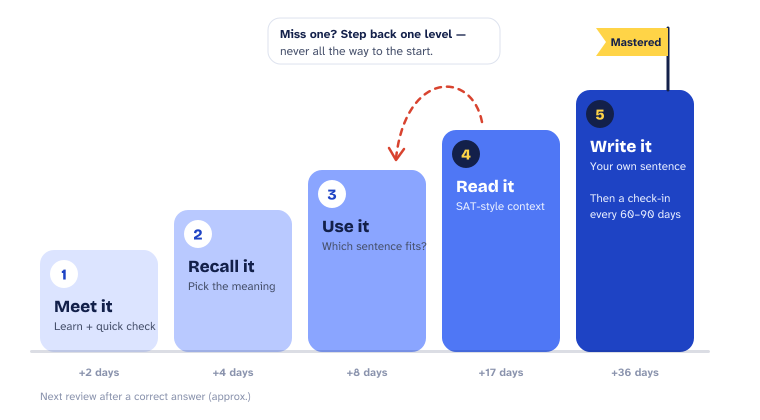
Each word climbs five levels, and each one asks for a little more:

  1. Meet it: learn the word, its meaning and an example, then a quick check.
  2. Recall it: pick the right meaning with no hints.
  3. Use it: choose the sentence that uses the word correctly.
  4. Read it in context: an SAT-style Words in Context question.
  5. Write it: your own original sentence. You can't fake a sentence.

Miss one? The word drops one level, not back to the start. Words return right before they'd slip from memory, which is what makes them stick.

The real advantage

Start early. That's the whole advantage.

A student cramming three months out has to squeeze vocabulary into an already punishing schedule, so it gets dropped first.

A student who starts in 9th or 10th grade will learn a handful of words a day, at the intervals memory research calls for, with no pressure at all. They walk into junior year with vocabulary already handled and a leg up on strategy.

Nothing is borrowed from test prep. Time is taken back from social media.

Built for everyone in a student's corner

  • Parents

    Screen-time limits that turn into study time, with no nagging.

  • Students

    Five minutes, then your phone. Fair and fast, and it actually helps.

  • Tutors

    Homework that gets done, a vetted list, and a log of every incorrect answer to guide and streamline your study sessions.

  • Teachers and counselors

    A low-lift, research-based habit to recommend to families.

“For as long as I can remember, parents have asked me, ‘Is one-on-one tutoring really necessary?’ The honest answer: it depends on the kid. Many students won't study on their own. Not because they can't, but because they are already busy and spread thin, because daily discipline at fifteen is rare and the SAT seems years away…right up until the day it isn't. SATShield builds motivation and discipline into the thing they already reach for forty times a day.”

Peyton McDavitt, founder and co-founder of Ivy Method Tutors with more than 20 years of test prep experience.

Quick questions

What is SATShield?

SATShield is an iPhone app that turns a teen's daily screen time into SAT vocabulary and test-strategy practice. A parent chooses which apps to lock, and a short daily session of 5–10 words unlocks them until a time the parent sets.

What grade should my student start in?

9th or 10th grade is ideal. Can a student start in 8th grade? Of course. Some students are simply ready early. Starting early, however, lets students learn a few words a day at the intervals memory research recommends, so vocabulary is handled before the busy junior-year prep season. Juniors and seniors can still benefit and use SATShield alongside prep, especially with a few months or more before their test.

How long does a daily session take?

About five minutes. Each session covers 5–10 words, with reviews of words that are due coming first, then new words if there's room.

Is SATShield available now, and how much does it cost?

Yes. SATShield is on the App Store for iPhone now. It's free to download and sold as an App Store subscription. It is $9.99/month or $99/year. It needs iOS 18 or later, and Apple handles all billing, cancellations and refunds.

All questions

Available now for iPhone.

Questions? We read every message.